
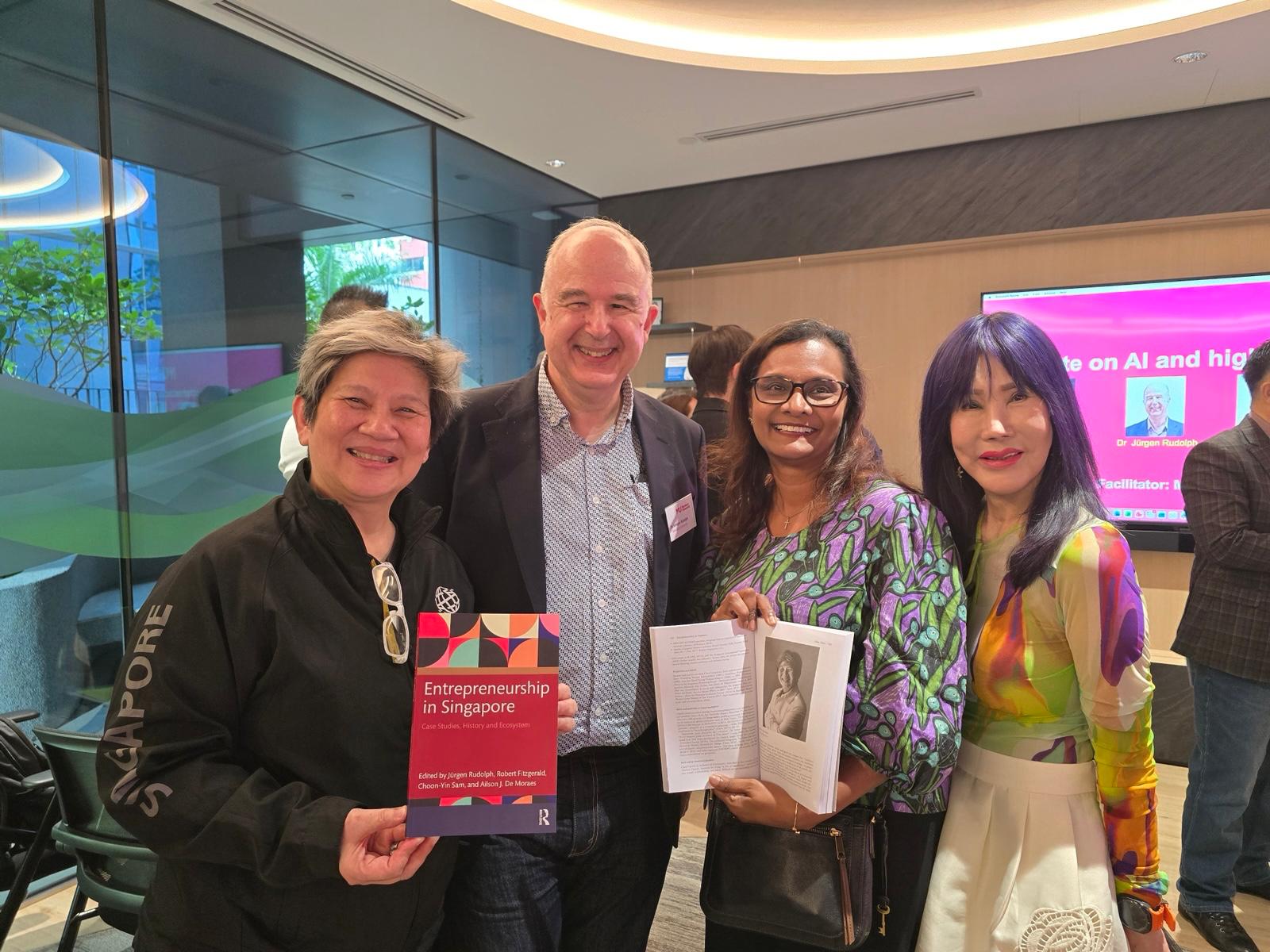
On 22 January 2026, PCDA President Charlotte George was the host of a lively book launch event at Kaplan City Campus. The evening saw the exploration of two interconnected themes: entrepreneurship in Singapore and the future of higher education in the age of artificial intelligence. Marked by energetic discussion and debate, the event brought together educators, business professionals, and entrepreneurs to confer around the implications of AI for teaching, learning, and employability.
Two newly published texts were the stars of the evening; Handbook of AI in Higher Education, published by Edgar Elwar Publishing, and Entrepreneurship in Singapore, published in December 2025 by Routledge. PCDA’s very own Charlotte George contributed to the latter of the publications as co-author of two of its chapters. Charlotte has over 20 years of experience working across education, employability and leadership development, and currently leads the employability and student engagement department at Kaplan Singapore.
‘Entrepreneurship in Singapore’ offers a timely examination of the context and characteristics of entrepreneurship in Singapore. The book looks at entrepreneurship in Singapore as shaped by systems, policy, and lived experience, rather than a lone, linear journey. Split into two parts, it first explores how Singapore’s business environment has evolved to support entrepreneurship and innovation, before turning to real case studies of local entrepreneurs. These stories challenge common myths about what it really takes to build a sustainable business in Singapore.
Charlotte’s chapters focus on the entrepreneurial journeys of Elim Chew and Dickrose Masalamani, highlighting how both figures emerge from marginal or stigmatised sectors and reframe them as socially and nationally productive forms of enterprise. Together, these case studies illustrate a model of entrepreneurship in Singapore that is values-led, relational, and institutionally embedded, aligning commercial success with social purpose.
Ultimately, the evening highlighted the importance of adaptability, ethical leadership, and preparing individuals for non-linear career paths. While technological change is accelerating, a human-centred, values-led approach to education and enterprise remains central to the incorporation of AI into the future of work and learning.