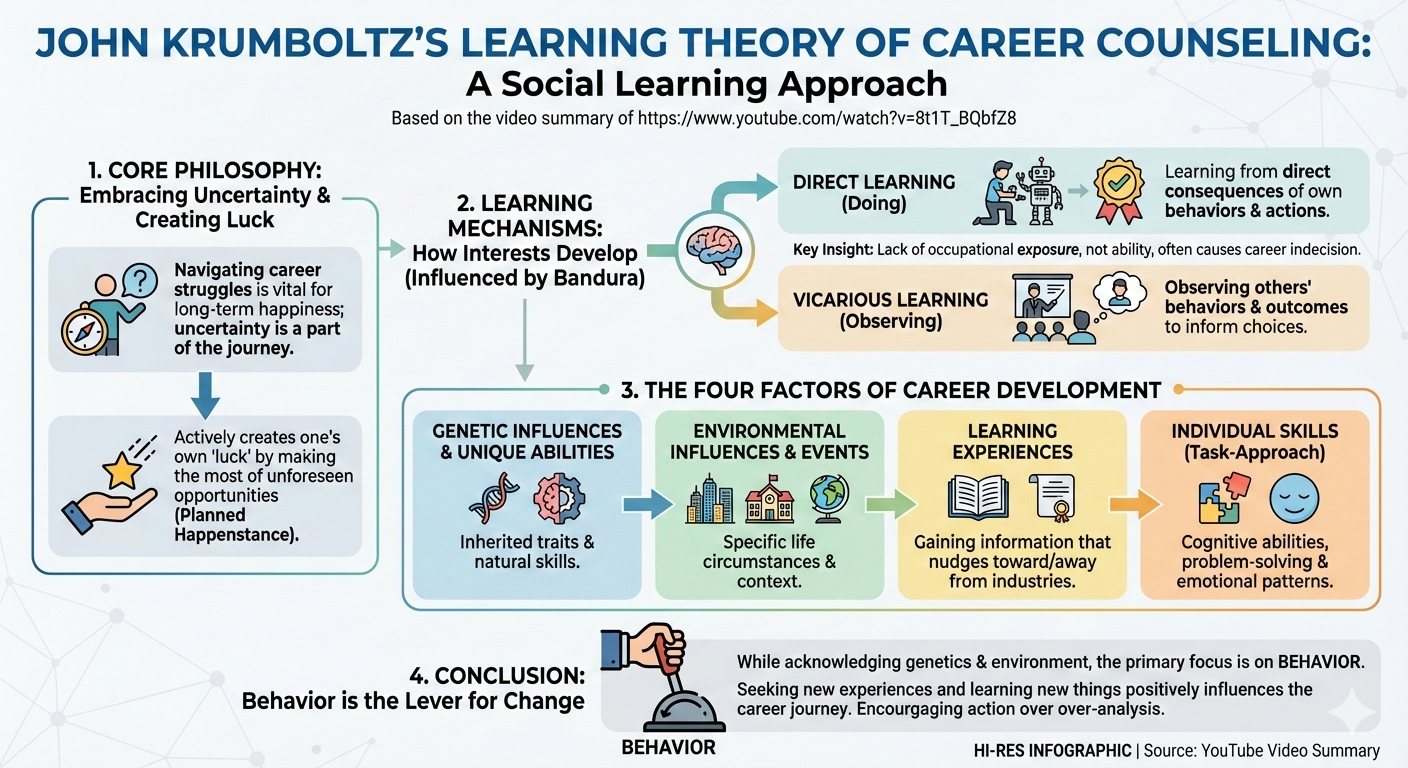
As career practitioners, we often meet clients who feel "stuck" or "lost" because they haven't found their one true calling. But, according to John Krumboltz’s Learning Theory of Career Counseling, that uncertainty is actually a vital part of the journey. Krumboltz’s work reminds us that career development isn't just about matching person to a job; it’s an ongoing process of social learning.
Key Takeaways for our Practice:
- Action over Analysis: Satisfying careers are built by actively creating "luck" and seizing unforeseen opportunities, a concept often known as Planned Happenstance.
- The Power of Exposure: Clients often struggle not because they lack ability, but because they haven't been exposed to enough environments to learn what fits.
- Learning Mechanisms: We develop interests through Direct Learning (doing the work) and Vicarious Learning (observing others).
- The 4 Influencers: Our clients are shaped by their genetics, their unique environments, their past learning experiences, and their specific task-approaching skills (like problem-solving and emotional patterns).
While genetics and environment play a role, Krumboltz emphasises that behaviour is the lever we can pull. By encouraging our clients to seek out new experiences and view "luck" as a skill to be developed, we empower them to navigate an unpredictable world.
Practitioner question: How do you help your clients move from "I don't know what to do" to "I'm going to try this and see what happens"?
To learn more, watch this youtube video about the Learning Theory of Career Counseling, and view the infographic below.